


 PLATFORM UPDATE:


Dual-modification of biochar via Fenton oxidation and in situ α-FeOOH synthesis for enhanced Cu(ii) removal: experimental investigation and theoretical calculation analysis

Abstract
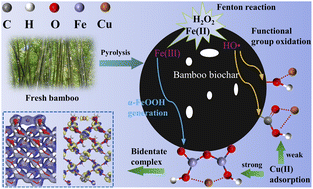
In the present study, a facile method combining Fenton oxidation and subsequent α-FeOOH deposition for dual-modification of biochar was developed to prepare an efficient adsorbent for removing Cu(II) from wastewater. Compared to pristine and single-modified biochars, the dual-modified biochar FOBC had a larger adsorption capacity for Cu(II). Comprehensive investigations encompassing adsorption isotherms, kinetic studies, and thermodynamic analysis showed that the FOBC-based adsorption of Cu(II) was dominated by an endothermic, monolayer, chemisorption process. Multiple characterization results showed that the primary mechanisms for the adsorption of Cu(II) were ion exchange and complexation reactions. The α-FeOOH deposited on the FOBC matrix played the most pivotal role during the adsorption of Cu(II). To explore the adsorption mechanisms at the electron scale, the density functional theory calculations were conducted. The findings suggested that the OA-site of α-FeOOH was an extremely robust adsorption site, binding with Cu(II) to form the bidentate complexes. Moreover, FOBC presented remarkable feasibility, reusability, and structural stability, demonstrating its potential application for treating Cu(II)-containing wastewater.
 Please wait while we load your content...


