


 PLATFORM UPDATE:

Advancing photovoltaics with Cs2NaInI6-based perovskites: a simulation study on ETL optimization

Abstract
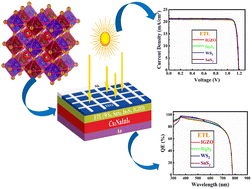
Developing reliable, energy-efficient, and eco-friendly photovoltaic materials is crucial for advancing next-generation solar technologies. Among lead-free options, double perovskites such as Cs2NaInI6 show strong potential due to their direct bandgap (∼1.6 eV), excellent light absorption, high carrier mobility, and environmental durability. The efficiency of Cs2NaInI6-based perovskite solar cells (PSCs), however, is strongly influenced by the electron transport layer (ETL). In this work, Solar Cell Capacitance Simulator in One Dimension (SCAPS-1D) simulations were employed to analyze ITO/ETL/Cs2NaInI6/Au structures using WS2, SnS2, In2S3, and IGZO as ETLs. Critical factors—absorber thickness, defect density, doping levels, interface traps, and temperature—were systematically tuned to assess their effects on power conversion efficiency (PCE), open-circuit voltage (VOC), short-circuit current density (JSC), and fill factor (FF). Among the tested ETLs, WS2 delivered the best performance with a PCE of 22.63%, VOC of 1.189 V, JSC of 21.406 mA cm−2, and FF of 88.92%, attributed to favorable band alignment, high mobility, and reduced recombination. Additionally, Cs2NaInI6 demonstrated promising thermal and defect stability, emphasizing its viability for real-world applications. Overall, this study underscores the critical role of ETL engineering and provides a simulation-guided approach for designing efficient lead-free perovskite solar cells (PSCs).
 Please wait while we load your content...


