


 PLATFORM UPDATE:


Recent progress in carbon coating and surface modification of LiFePO4 cathodes
 *a
Mohammad
Alkhedher
c
and
*a
Mohammad
Alkhedher
c
and
Abstract
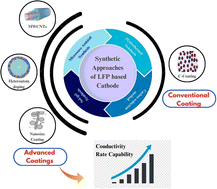
Lithium iron phosphate (LiFePO4, LFP) is widely recognized as a cathode material for lithium-ion batteries (LIBs) owing to its excellent high temperature stability, environmental compatibility and impressive cycle retention. Nevertheless, the limited lithium-ion migration rate and poor electronic/ionic conductivities of this material restrict its practical application. This review explores different methods for synthesizing LFP, such as hydrothermal, sol–gel, microwave-assisted, and carbon reduction techniques, assessing them in terms of structural control, scalability, and performance. Additionally, it highlights modification strategies that have evolved from traditional carbon coating to more advanced techniques, such as heteroatom doping in carbon layers, the integration of multi-walled carbon nanotubes (MWCNTs), and thin oxide nanoscale coatings. In this review, the advancements in utilization of LFP for conventional LIB applications as well as in all solid state lithium batteries (ASSLBs) are highlighted, pointing toward future directions for high performance and durable energy storage technologies.
- This article is part of the themed collection: 2025 Reviews in RSC Advances
 Please wait while we load your content...


