


 PLATFORM UPDATE:


Pyrazolyl-functionalised Ag(i)–NHC complexes: synthesis, characterisation, antibacterial activity, and computational investigation
 a
Karen
Pillay,
b
Janade
Moodley,
b
Thishana
Singh,
a
Bernard
Omondi
a
and
Muhammad D.
Bala
*a
a
Karen
Pillay,
b
Janade
Moodley,
b
Thishana
Singh,
a
Bernard
Omondi
a
and
Muhammad D.
Bala
*a
Abstract
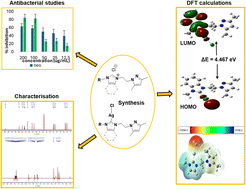
In this study, five pyrazolyl-functionalised azolium salts with varying N-substituents (R-group) on the (benz)imidazolium rings, i.e. 3-(2-(3,5-dimethyl-1H-pyrazol-1-yl) ethyl)-1-R-1H-imidazole-3-ium chloride, where R = methyl (1a), ethyl (1b), benzyl (1c) and 3-(2-(3,5-dimethyl-1H-pyrazol-1-yl)ethyl)-1-R-1H-benzo[d]imidazole-3-ium chloride, where R = methyl (1d), ethyl (1e) were synthesised. Corresponding silver(I)–N-heterocyclic carbene complexes 2a–e were also synthesised from the deprotonation of the salts. All the compounds were characterised by spectroscopic and analytical techniques. In addition, all the salts and Ag(I) complexes were utilised as in vitro antibacterial agents against a broad spectrum of bacterial strains. Among the synthesised complexes, compound 2c bearing a benzyl N-substituent demonstrated the highest potency with IC50 values and bacterial inhibition percentages comparable to the standard drug neomycin. Theoretical methods, including DFT calculations, were used to examine electronic effects and SWISSADME to predict enhanced activity for the benzimidazole-containing compounds as compared to those bearing simple imidazole. Also examined is the role of the N-benzyl moiety in enhancing the antibacterial activity of complex 2c.
 Please wait while we load your content...


