


 PLATFORM UPDATE:


Investigations on the impact of nickel doping on thermoelectric properties in n-type Bi1.8Sb0.2Te3 alloy
 a
Poornesh
P.,
a
a
Poornesh
P.,
a
Abstract
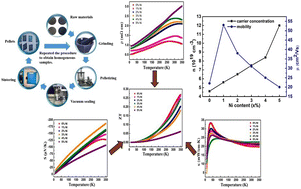
The incorporation of transition metals into alloys allows for the modification of carrier concentration and the optimization of electrical transport properties. This study investigates the impact of Ni on the thermoelectric properties of the Bi1.8Sb0.2Te3 alloy. Samples of Bi1.8Sb0.2Te3/x%Ni with varying Ni concentrations (x = 0, 1, 2, 3, 4, and 5) were synthesized using the solid-state reaction method, resulting in homogeneous, dense compounds characterized by a rhombohedral crystal structure and granular morphology. The electrical resistivity exhibits a gradual increase with increase in Ni concentration, attributed to enhanced electron scattering that diminishes carrier mobility. The negative Seebeck coefficients suggest that electron-dominant charge carriers predominantly influence the thermoelectric transport of the Bi1.8Sb0.2Te3 system. The maximum Seebeck coefficient recorded is approximately 185 μV K−1 for the Bi1.8Sb0.2Te3/3%Ni sample. The lattice thermal conductivity significantly contributes to the overall thermal conductivity, which increases with the addition of Ni due to the reduction in point defect scattering resulting from the Ni incorporation. The pristine sample demonstrates the lowest thermal conductivity of 19 mW cm−1 K−1 at 350 K. The highest power factor is approximately 1.56 mW mK−2 at 350 K, which is nearly identical for samples with compositions x = 0 and x = 1% Ni. The highest figure of merit (ZT) achieved is approximately 0.27 for the pristine sample at 350 K.
 Please wait while we load your content...


