


 PLATFORM UPDATE:


Enhancement of antimicrobial and structural properties of PVA packaging films using neem leaf powder: an example for extending the shelf life of cowpeas

Abstract
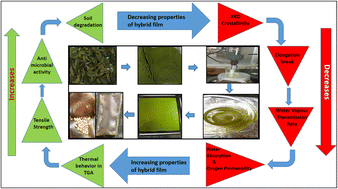
This study focused on the fabrication and characterization of polyvinyl alcohol (PVA)/Azadirachta indica (neem leaf) hybrid films for use in active food packaging. PVA/AiP hybrid films were prepared using a solution casting technique with varying concentrations of AiP (0.1, 0.5, 1.0, 1.5, and 2.0 g) as a bio-filler. The films were comprehensively characterized using FTIR, XRD, SEM, optical microscopy, TGA/DSC, water absorption, oxygen permeability, mechanical strength, water vapor transmission rate, soil degradability, and antimicrobial activity tests. TGA/DSC showed improved thermal stability of the hybrid films (up to 330 °C) with increasing AiP content. Water absorption increased with AiP incorporation, peaking at 0.5 g, (130% at 60 min) while oxygen permeability was highest for the 0.5 g AiP film (∼8.0 mg L−1 at 72 hours). At 2 g AiP loading, the film showed noticeable brittleness, making it unsuitable for conventional film applications. Hence, it was not compared with the lower concentration films, but its barrier properties were evaluated separately. Tensile strength significantly improved at 2 g AiP loading (18.82 MPa). Water vapor transmission rate progressively reduced with increasing AiP content. Soil degradability was enhanced at 0.1 g AiP (74.5%) but decreased at higher loadings (55.4%). Antimicrobial activity against E. coli increased with AiP concentration. Compared to pure PVA films (tensile strength 12–15 MPa, WVTR 6.0–7.2 g mm m−2 day−1 kPa−1) and commercial PET films (tensile strength 55–75 MPa, WVTR 2.0–3.0 g mm m−2 day−1 kPa−1), the PVA/AiP hybrid films exhibited superior barrier performance and antimicrobial activity while being biodegradable. The findings demonstrated the potential of PVA/AiP hybrid films as sustainable and effective active food packaging materials. This supports the achievement of sustainable development goal (SDG) 12, which focuses on responsible consumption and production. Unlike pure PVA or conventional plastics, PVA/AiP hybrid films combined superior performance with biodegradability and antimicrobial activity.
 Please wait while we load your content...


