


 PLATFORM UPDATE:


Electrochemical evaluation of EVA/ZnO nanocomposite coatings: achieving superior electrochemical corrosion protection in harsh environments
 *a
S. I.
El-Dek
a
and
*a
S. I.
El-Dek
a
and
Abstract
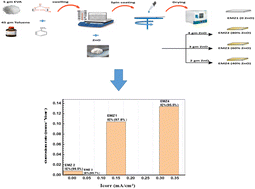
The development of polymer-based composite coatings with high quality and efficiency for corrosion resistance has become increasingly significant, particularly in harsh environmental conditions. In this context, a composite coating (EMZ3) was successfully formulated with an optimal blending ratio of ethylene-vinyl acetate (EVA) copolymer and 60% synthesized nano-sized zinc oxide (ZnO), tailored via co-precipitation to ensure uniform dispersion and enhanced corrosion resistance, using the mechanical blending technique. This environmentally friendly coating demonstrated exceptional protective performance compared to other coatings with varying ZnO concentrations. The mechanical blending method enhanced the coating's long-term protective capabilities through homogeneous and proportional distribution of the components. Electrochemical impedance spectroscopy (EIS) results indicated increasing charge transfer resistance and sustained stability over a 28 day immersion period in a 3.5% sodium chloride solution. The creation of environmentally friendly, corrosion-resistant coatings is made possible by this research's innovative integration of recycled EVA/ZnO composites from industrial waste. This study opens avenues for incorporating recycled polymers from industrial waste, enabling the production of more efficient protective coatings and environmentally friendly solutions.
 Please wait while we load your content...


