Issue 57, 2025, Issue in Progress

Unveiling the mechanism of the electroreduction of CO2 to CO over ZIF-8, ZIF-67, and ZIF-90: a DFT perspective

Abstract

The carbon dioxide reduction reaction (CO2RR) is an important solution for reducing carbon levels. Achieving high selectivity and low cost for the catalyst are the main challenges. In this study, computational approaches at the density functional theory (DFT) level are employed to investigate the catalytic activity and mechanism of the conversion of CO2 to CO by zeolitic imidazolate framework (ZIF)-based catalysts (ZIF-8, ZIF-67, ZIF-90). Analysis of the activation energy (Ea) barrier reveals that ZIF-8 is the most efficient (Ea = 0.39 eV) among the considered catalysts. The quantum theory of atoms in molecules (QTAIM) and noncovalent interaction index (NCI) analyses during the activation step of the CO2 molecule reveal the partial covalent and strong electrostatic interactions between the analyte (CO2 molecule) and the catalysts (ZIF-8, ZIF-67, and ZIF-90) at various sites. The natural bonding orbitals (NBO) and electron density difference (EDD) analyses confirm the charge redistribution and bending of the CO2 molecule as it interacts with the catalyst surface during the activation step. Overall, the study's findings indicate ZIF-8 to be the most stable and effective electrocatalyst surface for the CO2RR.
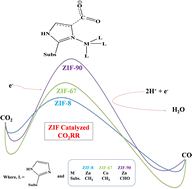
Graphical abstract: Unveiling the mechanism of the electroreduction of CO2 to CO over ZIF-8, ZIF-67, and ZIF-90: a DFT perspective

Supplementary files

Article information

Article type
Paper
Submitted
27 Jul 2025
Accepted
23 Nov 2025
First published
11 Dec 2025
This article is Open Access
Creative Commons BY-NC license

RSC Adv., 2025,15, 49455-49467

Unveiling the mechanism of the electroreduction of CO2 to CO over ZIF-8, ZIF-67, and ZIF-90: a DFT perspective

I. Hussain, U. Farooq and K. Ayub, RSC Adv., 2025, 15, 49455 DOI: 10.1039/D5RA05431A

This article is licensed under a Creative Commons Attribution-NonCommercial 3.0 Unported Licence. You can use material from this article in other publications, without requesting further permission from the RSC, provided that the correct acknowledgement is given and it is not used for commercial purposes.

To request permission to reproduce material from this article in a commercial publication, please go to the Copyright Clearance Center request page.

If you are an author contributing to an RSC publication, you do not need to request permission provided correct acknowledgement is given.

If you are the author of this article, you do not need to request permission to reproduce figures and diagrams provided correct acknowledgement is given. If you want to reproduce the whole article in a third-party commercial publication (excluding your thesis/dissertation for which permission is not required) please go to the Copyright Clearance Center request page.

Read more about how to correctly acknowledge RSC content.

Social activity

Spotlight

Advertisements