


 PLATFORM UPDATE:


Two-dimensional TaS2 as a contact material for MXene Sc2CF2 semiconductors: a first-principles study

Abstract
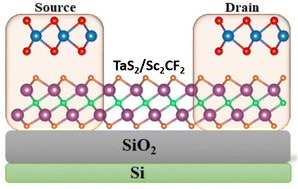
Metal–semiconductor heterojunctions are fundamental to modern electronics, serving as the key interface for charge transport and enabling diverse functionalities in electronic and optoelectronic devices. In this work, we computationally design the electrical contact architecture by vertically integrating two-dimensional TaS2 and Sc2CF2 materials using first-principles predictions. The TaS2/Sc2CF2 heterostructure is predicted to be energetically and thermally stable at room temperature and characterized by weak van der Waals interactions. Additionally, the integration of TaS2 with Sc2CF2 enhances the mechanical rigidity of the heterostructure. More interestingly, the TaS2/Sc2CF2 heterostructure forms a Schottky contact with an electron barrier of 0.36 eV. Furthermore, it exhibits remarkable tunability in electronic properties and contact behavior under an applied electric field. Specifically, the electric field induces a transition from Schottky to ohmic contact, as well as a conversion from n-type to p-type Schottky contact. This tunability signifies a barrier-free charge injection process, making the TaS2/Sc2CF2 heterostructure a promising candidate for next-generation electronic and optoelectronic devices.
 Please wait while we load your content...


