


 PLATFORM UPDATE:


Design and analysis of a plasmonic-nanorod-enhanced lead-free inorganic perovskite/silicon heterojunction tandem solar cell exceeding the Shockley–Queisser limit

Abstract
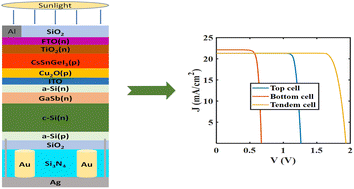
The pursuit of sustainable and highly efficient energy conversion necessitates a transition from toxic and unstable materials to environmentally friendly alternatives. This work presents a simulation-based numerical investigation of a fully inorganic, lead-free tandem solar cell that employs cesium tin-germanium tri-iodide (CsSnGeI3) as the top cell absorber and crystalline silicon (c-Si) as the bottom cell absorber, configured in a silicon heterojunction (SHJ) arrangement. Utilizing CsSnGeI3 as a lead-free perovskite presents a promising solution to the toxicity concerns associated with conventional lead-based perovskites. To further increase near-infrared absorption and reduce the required thickness of the c-Si layer, an ultra-thin gallium antimonide auxiliary absorber is integrated into the SHJ bottom cell. Optical and electrical simulations, conducted using finite-difference time-domain and drift-diffusion modelling, demonstrate that the optimized tandem structure attains a power conversion efficiency of 34.93%, surpassing the Shockley–Queisser limit established for single-junction Si cells. Furthermore, the optimized device showcases an open-circuit voltage of 1.93 V, a short-circuit current density of 21.30 mA cm−2, and a fill factor of 84.74%. Performance is additionally enhanced by incorporating cylindrical gold nanorods within a Si3N4 dielectric medium positioned at the rear of the bottom cell, thus amplifying light absorption through plasmonic effects. Notably, the tandem cell sustains high efficiency even without the plasmonic structure, thereby providing flexibility for cost-effective fabrication. This work underscores the viability of all-inorganic, lead-free tandem cells for next-generation photovoltaics, guided by simulated results that pave the way for high-efficiency, non-toxic solar energy solutions and further experimental validation.
 Please wait while we load your content...


