


 PLATFORM UPDATE:


Enhancing amantadine delivery through PLGA micelles: a novel approach using oleic acid and Pluronic F68 for sustained release and reduced toxicity

Abstract
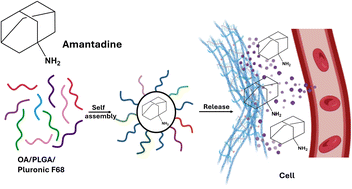
Micelles are emerging as effective drug delivery carriers. This study presents the encapsulation of amantadine, a treatment for Parkinson's disease, into poly (lactic-co-glycolic acid) (PLGA) micelles using Pluronic F68 and oleic acid (OA) surfactants. These surfactants were selected for their ability to control drug release kinetics and protect the drug from enzymatic degradation. Dynamic light scattering (DLS) revealed that the prepared Amantadine/OA-Pluronic F68-PLGA micelles had a uniform hydrodynamic diameter of 182.4 ± 3.4 nm with a low polydispersity index (PDI) of 0.137. Transmission electron microscopy (TEM) confirmed the spherical structure, with a core–shell configuration: the inner hydrophobic core composed of oleic acid, polypropylene oxide (PPO), and poly(lactic-co-glycolic acid (PLGA), and an outer hydrophilic shell of polyethylene oxide (PEO) and glycolic acid (GA). Fourier-transform infrared (FTIR) spectroscopy indicated a decreased intensity of the carbonyl (C![[double bond, length as m-dash]](https://www.rsc.org/images/entities/char_e001.gif) O) stretching band at 1750 cm−1, while the C–O–C stretching peak at 1050 cm−1 remained unchanged. Additional functional group peaks at 1450 cm−1 (–CH3) and 1226 cm−1 (C–N) further supported the micelle formation and amantadine encapsulation. In vitro cytotoxicity assays (such as MTT and SRB) showed a concentration-dependent reduction in J774 cell viability, with toxicity reduced to below 10% when amantadine was encapsulated. This formulation enables controlled release, potentially reducing administration frequency while extending therapeutic efficacy. The novelty of this study lies in the combination of Pluronic F68 and oleic acid surfactants, enhancing drug stability and delivery efficiency, making it a promising approach for improving amantadine delivery in Parkinson's treatment.
O) stretching band at 1750 cm−1, while the C–O–C stretching peak at 1050 cm−1 remained unchanged. Additional functional group peaks at 1450 cm−1 (–CH3) and 1226 cm−1 (C–N) further supported the micelle formation and amantadine encapsulation. In vitro cytotoxicity assays (such as MTT and SRB) showed a concentration-dependent reduction in J774 cell viability, with toxicity reduced to below 10% when amantadine was encapsulated. This formulation enables controlled release, potentially reducing administration frequency while extending therapeutic efficacy. The novelty of this study lies in the combination of Pluronic F68 and oleic acid surfactants, enhancing drug stability and delivery efficiency, making it a promising approach for improving amantadine delivery in Parkinson's treatment.
 Please wait while we load your content...


