


 PLATFORM UPDATE:


AC corona aging behavior and performance comparison of HTV silicone rubber, cycloaliphatic epoxy resin, and glass fiber-reinforced epoxy used in composite insulators

Abstract
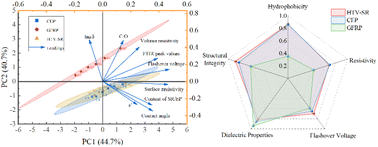
Cycloaliphatic epoxy resin (CEP) is a promising candidate for rigid housings in high-voltage composite insulators due to its superior hardness, water resistance, and interfacial adhesion compared with conventional high-temperature vulcanized silicone rubber (HTV-SR). However, the long-term insulation degradation mechanisms of CEP under corona discharge are still not fully understood. In this study, CEP, HTV-SR, and glass fiber-reinforced epoxy (GFRP) were subjected to AC corona aging using a multi-needle plate electrode. Surface morphology, chemical structure, and electrical properties were comprehensively evaluated. The results show that all three materials experienced progressive surface cracking and increased roughness during aging, leading to notable reductions in hydrophobicity, resistivity, and DC flashover voltage. Surface degradation was found to be more significant than bulk degradation. CEP maintained a denser microstructure containing carbonized residues and inorganic fillers, and exhibited less severe cracking compared with HTV-SR. FTIR and XPS analyses revealed that CEP underwent epoxy ring opening, accumulation of polar groups, and surface carbonization, accompanied by a marked decrease in the C/O ratio and deterioration of dielectric properties. In comparison, HTV-SR developed a protective silica-like layer through oxidative crosslinking, which helped preserve its structural integrity and insulation performance. GFRP suffered the most severe deterioration, including resin erosion and glass fiber exposure. Principal component analysis (PCA) of multiple performance indicators confirmed that CEP demonstrated aging resistance comparable to HTV-SR and superior to GFRP. These findings provide a theoretical foundation for the engineering application of CEP in high-voltage composite insulators.
 Please wait while we load your content...


