


 PLATFORM UPDATE:


Bacterial adhesion and erythrocyte integrity on polycaprolactone nanowire surfaces

Abstract
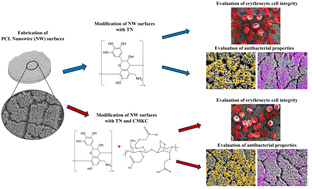
Blood-contacting devices (BCDs), such as blood collection bags, blood tubes, artificial heart valves, vascular grafts and catheters, are subject to complications such as thrombosis, restenosis, hemolysis etc. These complications result in poor hemocompatibility and bacterial infections on the surfaces of BCDs that ultimately affect the patient's health. Natural and synthetic biocompatible polymers are used as potential solutions for these issues due to their superior biodegradability. Recent advancements in nanoscale fabrication and modification of these surfaces have shown improved results with platelets, leukocytes and other whole blood components. However, disruptions in erythrocyte's cell structure, caused by the foreign body materials, can compromise their oxygen-carrying capacity. This can further affect the overall tissue oxygenation and potentially lead to myocardial ischemic conditions. Therefore, it is vital to understand the effect of BCD's surface properties on erythrocyte integrity and viability. Additionally, bacterial adhesion on these BCDs surfaces can cause severe infections like bacteremia, that can further escalate into sepsis. Biofilms and bacterial colonies can act as pro-thrombotic surfaces themselves, which increases the risk of device-associated thrombosis. Hence, improving the antibacterial properties of the BCDs surfaces is also essential to prevent bacterial growth and biofilm formation on its surfaces. In this study, PCL nanostructured surface: nanowires were fabricated and modified with organic compounds: Tanfloc (TN) and Carboxymethyl Kappa-Carrageenan (CMKC) to investigate their antibacterial properties and their effect on erythrocyte's cell integrity. Results indicate that the modified PCL nanowires retain the erythrocyte integrity better and exhibit enhanced antibacterial properties.
 Please wait while we load your content...


