


 PLATFORM UPDATE:


Ruthenium-based electrocatalyst for efficient acidic water oxidation in PEM water electrolysis for H2 production
 *ab
*ab
Abstract
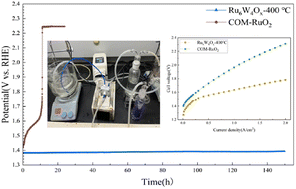
Proton exchange membrane (PEM) water electrolysis is a promising and sustainable technology for hydrogen production. Currently, the anode catalysts used in PEM water electrolysis are predominantly iridium-based electrocatalysts, which are extremely precious and scarce. In this study, we report a mixed (Ru–W)Ox catalyst as a promising alternative to iridium-based catalysts. The (Ru–W)Ox catalyst was synthesized using a simple Pechini–Adams method, and its microstructure and electrochemical performance were optimized by controlling the Ru/W doping ratio and the synthesis temperature. Among the synthesized catalysts, the Ru6W4Ox catalyst prepared at 400 °C demonstrated the best oxygen evolution reaction (OER) activity and stability, achieving an overpotential of only 140.32 mV at 10 mA cm−2. Furthermore, after a 150 hours stability test, no significant loss in catalytic activity was observed. When applied to the anode of a PEM water electrolyzer, the Ru6W4Ox-400 °C catalyst exhibited an impressively low cell voltage of 1.784 V at 2 A cm−2. The energy consumption is as low as 4.34 kWh m−3 H2. These results provide new insights for developing efficient and stable non-iridium-based OER catalysts for PEM water electrolysis.
 Please wait while we load your content...


