


 PLATFORM UPDATE:


Mechanistic insights into the (3 + 2) cycloaddition of azomethine ylide with dimethyl acetylenedicarboxylate via bond evolution theory
 ab
Raad Nasrullah
Salih,
d
Lakhdar
Benhamed,
e
Sofiane
Benmetir,
fg
Jesus
Vicente de Julián-Ortiz,
f
Haydar A.
Mohammad-Salim
hi
and
Ali
Ben Ahmed
*jk
ab
Raad Nasrullah
Salih,
d
Lakhdar
Benhamed,
e
Sofiane
Benmetir,
fg
Jesus
Vicente de Julián-Ortiz,
f
Haydar A.
Mohammad-Salim
hi
and
Ali
Ben Ahmed
*jk
Abstract
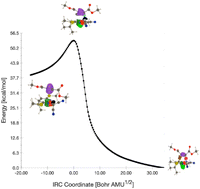
The mechanistic pathway of the (3 + 2) cycloaddition (32CA) between azomethine ylide 1 and dimethyl acetylenedicarboxylate 2, affording 4-isoxazoline derivatives, was elucidated via Density Functional Theory (DFT) calculations employing the B3LYP-D3 functional and the 6-311++G(d,p) basis set in 1,4-dioxane. Reactivity insights derived from Conceptual DFT (CDFT) demonstrated that compound 1 behaves as an ambiphilic species with significant nucleophilic and electrophilic tendencies, whereas compound 2 functions predominantly as an electrophile. These electronic features reveal a marked polarity in the cycloaddition and align with a forward electron density flux (FEDF) governing the reaction process. Natural Population Analysis (NPA) and Parr functions identified the C3 carbon of 1 as the most nucleophilic center and the C4/C5 carbons of 2 as the most electrophilic, suggesting initial C3–C4 bond formation. Thermodynamic analysis showed the endo cycloadduct to be more stable, while kinetic data favored the exo pathway, suggesting a kinetically controlled mechanism that ultimately leads to thermodynamically preferred endo-selectivity. The geometries of the transition states revealed asynchronous bond formation, with the exo pathway exhibiting a higher degree of asynchronicity. Global Electron Density Transfer (GEDT) values confirmed the moderately to distinctly polar nature of the pathways. Finally, detailed Electronic Localization Function (ELF) topological analysis and Bonding Evolution Theory (BET) elucidated the asynchronous, multistage mechanism involving six structural stability domains (SSDs), characterizing the formation of new bonds through a sequence of topological catastrophes. Non-Covalent Interaction (NCI) analysis provided visual and quantitative evidence of attractive and repulsive intermolecular forces influencing the TS geometries.
 Please wait while we load your content...


