


 PLATFORM UPDATE:


Low-temperature phosphidation synthesis of flower-like Ru-CoVO-P polymetallic catalyst for enhanced overall water splitting in alkaline seawater
 *a
and
Lihua
Miao
*b
*a
and
Lihua
Miao
*b
Abstract
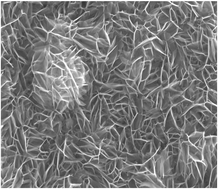
Developing efficient and stable bifunctional electrocatalysts for overall water splitting, especially in practical electrolytes such as seawater, remains a significant challenge in the field of energy conversion. Herein, we report the successful synthesis of a three-dimensional, flower-like polymetallic phosphide electrocatalyst (Ru-CoVO-P), constructed from self-assembled ultrathin nanosheets, via a facile hydrothermal method combined with a low-temperature phosphidation strategy. The catalyst exhibits excellent bifunctional activity in 1 M KOH, requiring overpotentials of only 88.7 mV (HER) and 248.3 mV (OER) to achieve 10 mA cm−2. After 240 hours of cycling in a two-electrode system, a cell voltage of only 1.753 V is required to achieve a current density of 50 mA cm−2. More importantly, the catalyst maintains excellent performance in 1 M KOH containing seawater, demonstrating outstanding stability and great application potential. The superior performance stems from the electronic structure modulation among the polymetallic components, as well as the abundant active sites and efficient mass transport capabilities provided by the hierarchical structure. This work provides a facile and effective synthesis strategy for developing advanced polymetallic phosphide catalysts suitable for practical seawater electrolysis.
 Please wait while we load your content...


