Issue 43, 2025, Issue in Progress

Tuning polyaniline doped with poly(4-styrenesulfonic acid) (PANI : PSS) as a nano-drug carrier for insulin delivery

Abstract

Polyaniline (PANI) is one of the most well-known conductive polymers, but it is not soluble in water. PSS, a polyelectrolyte and dopant, has demonstrated the ability to enhance both electrical conductivity and solubility in water. PANI : PSS were synthesized under the effect of polymerization times, oxidant (APS) ratios, and dopant (PSS) ratios. The suitable synthesized PANI : PSS was the ANI : APS mole ratio of 1 : 1 and ANI : PSS wt ratio of 1 : 5 for 24 h providing the highest electrical conductivity (6.84 x 10⁻² ± 4.30 x 10⁻⁴ S cm−1) and still remained as nanoparticles (42.11 ± 7.41 nm). Insulin, a model drug, was ion-exchanged with PANI : PSS, replacing PSS. The amount of insulin loaded into PANI : PSS (insulin-PANI : PSS) was varied with weight ratios of 0.5 : 1, 1 : 1, and 3 : 1, with the 1 : 1 wt ratio exhibiting 96.4% loading efficiency. The synthesized PANI : PSS is demonstrated as a potential insulin carrier for transdermal drug delivery.
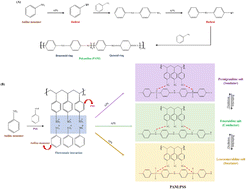
Graphical abstract: Tuning polyaniline doped with poly(4-styrenesulfonic acid) (PANI : PSS) as a nano-drug carrier for insulin delivery

Supplementary files

Article information

Article type
Paper
Submitted
11 Jul 2025
Accepted
14 Sep 2025
First published
29 Sep 2025
This article is Open Access
Creative Commons BY-NC license

RSC Adv., 2025,15, 35883-35891

Tuning polyaniline doped with poly(4-styrenesulfonic acid) (PANI : PSS) as a nano-drug carrier for insulin delivery

R. Morarad, P. Sakunpongpitiporn, K. Rotjanasuworapong, N. Paradee, W. Prissanaroon-Ouajai and A. Sirivat, RSC Adv., 2025, 15, 35883 DOI: 10.1039/D5RA04956C

This article is licensed under a Creative Commons Attribution-NonCommercial 3.0 Unported Licence. You can use material from this article in other publications, without requesting further permission from the RSC, provided that the correct acknowledgement is given and it is not used for commercial purposes.

To request permission to reproduce material from this article in a commercial publication, please go to the Copyright Clearance Center request page.

If you are an author contributing to an RSC publication, you do not need to request permission provided correct acknowledgement is given.

If you are the author of this article, you do not need to request permission to reproduce figures and diagrams provided correct acknowledgement is given. If you want to reproduce the whole article in a third-party commercial publication (excluding your thesis/dissertation for which permission is not required) please go to the Copyright Clearance Center request page.

Read more about how to correctly acknowledge RSC content.

Social activity

Spotlight

Advertisements