


 PLATFORM UPDATE:


Auto-luminescence study of thermal unfolding of DNA G-quadruplexes

Abstract
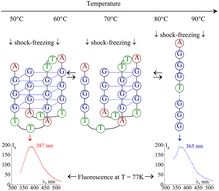
A new method for monitoring the unfolding of G-quadruplex DNA (G4) was proposed based on the native luminescence of the G4 system during its stepwise thermal denaturation. An antiparallel quadruplex formed by the Tel22 oligonucleotide (a fragment of human telomeric DNA) was used as a model in this study. Pre-folded G4 samples heated to various temperatures in the range of 50–90 °C were shock-frozen to trap the intermediates, and their low-temperature fluorescence and phosphorescence spectra were recorded. It was shown that effective unfolding of Tel22-G4 occurs in the region of 60–70 °C, and the process stops at temperatures above 80 °C. G4-associated fluorescence (λ = 387 nm) was found to decrease with increasing temperature, while the emission at 365 nm, corresponding to the unfolded Tel22 (and possibly to partially unfolded intermediates), increased. These spectral changes, along with the appearance of G-base emission in the Tel22 phosphorescence spectrum, are associated with the thermal denaturation of the G-quadruplex structure. A transition midpoint temperature (Tm) within 64–67 °C was obtained for Tel22-G4 from the temperature dependence of fluorescence at two wavelengths. The proposed approach allowed, for the first time, to monitor the unfolding of quadruplex DNA using its intrinsic luminescence and offered new insights into the nature of this process.
 Please wait while we load your content...


