


 PLATFORM UPDATE:


Proton-coupled pseudocapacitive behavior of a manganese oxide-decorated nitrogen-rich COP for sustainable high-performance energy storage devices
 *a
M.
Selvakumar
a
and
*a
M.
Selvakumar
a
and
Abstract
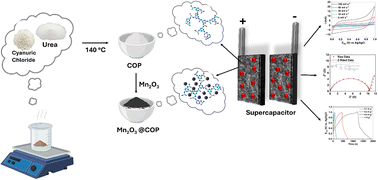
A hierarchical hybrid material (Mn2O3@COP) with dual charge storage capabilities was created by synthesizing a triazine-based covalent organic polymer (COP) that is rich in nitrogen functionalities and integrating it with Mn2O3 nanoparticles. Fourier transform infrared spectroscopy (FTIR), X-ray diffraction (XRD), scanning electron microscopy (SEM), energy dispersive X-ray spectroscopy (EDS), Brunauer–Emmett–Teller (BET) studies, and X-ray photoelectron spectroscopy (XPS) demonstrated a distinct architecture: Mn2O3 nanoparticles were uniformly embedded in a stable, porous COP matrix. Mn2O3 loading caused a modest decrease in surface area, but the composite still had the mesoporosity needed for quick ion diffusion. The existence of electroactive nitrogen centers—pyridinic, pyrrolic, and graphitic—and mixed-valence Mn3+/Mn4+ species, which together improve redox kinetics and charge transfer routes, was verified by XPS analysis. An intriguing combination of electric double-layer capacitance (EDLC) and pseudocapacitive behavior was demonstrated by electrochemical experiments in a 1 M H2SO4 electrolyte. The Mn2O3@COP composite electrode in the three-electrode system had a high specific capacitance of 113 F g−1 at 5 mV s−1 and 69.1 F g−1 at 0.1 A g−1, an energy density of 9.6 Wh kg−1 and a power density of 500 W kg−1 at 0.1 A g−1. The fabricated symmetric supercapacitor device maintained 95% of its capacitance after 10 000 charge–discharge cycles at 0.5 A g−1 and provided a specific capacitance of 16.2 F g−1 and energy density and power density of 2.25 Wh kg−1 and 250 W kg−1 at 0.2 A g−1, respectively. This study offers a viable method for combining the energy density of transition metal oxides with the quick kinetics of conductive organic networks, opening the door to long-lasting, highly effective energy storage devices.
 Please wait while we load your content...


