Issue 52, 2025, Issue in Progress

Filtration behavior and associated mechanisms of kaolinite and illite with emphasis on pH effect

Abstract

The filterability and mechanisms of individual kaolinite and illite particles and their mixture have been investigated in aqueous solutions at different pH values by measuring the filtration rate and chord length distributions. The filtration rate decreased with pH values varying from 3 to 10, while the chord length distribution results showed that the clay mixture aggregated most significantly at pH 3. The particle interaction energy of the clay mixture, calculated according to the Derjaguin–Landau–Verwey–Overbeek (DLVO) theory, was determined to be attractive at pH 3. The pore size distribution (PSD) and porosity of the clay mixture filter cake were measured using the low-field nuclear magnetic resonance (LF-NMR) nanopore analyzer. The total porosity of the filter cake at pH 3 was higher than that at pH 10, leading to a higher filtration rate. It has been found from this study that the clay filterability depends on filter cake porosity, microstructure and the interaction of particles in the filter cake.
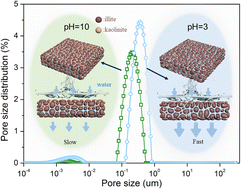
Graphical abstract: Filtration behavior and associated mechanisms of kaolinite and illite with emphasis on pH effect

Transparent peer review

To support increased transparency, we offer authors the option to publish the peer review history alongside their article.

View this article’s peer review history

Article information

Article type
Paper
Submitted
08 Jul 2025
Accepted
26 Sep 2025
First published
12 Nov 2025
This article is Open Access
Creative Commons BY-NC license

RSC Adv., 2025,15, 44093-44101

Filtration behavior and associated mechanisms of kaolinite and illite with emphasis on pH effect

G. Liu, X. Xu, R. Chen, H. Shao, D. Tao, L. Yang and X. Bu, RSC Adv., 2025, 15, 44093 DOI: 10.1039/D5RA04866D

This article is licensed under a Creative Commons Attribution-NonCommercial 3.0 Unported Licence. You can use material from this article in other publications, without requesting further permission from the RSC, provided that the correct acknowledgement is given and it is not used for commercial purposes.

To request permission to reproduce material from this article in a commercial publication, please go to the Copyright Clearance Center request page.

If you are an author contributing to an RSC publication, you do not need to request permission provided correct acknowledgement is given.

If you are the author of this article, you do not need to request permission to reproduce figures and diagrams provided correct acknowledgement is given. If you want to reproduce the whole article in a third-party commercial publication (excluding your thesis/dissertation for which permission is not required) please go to the Copyright Clearance Center request page.

Read more about how to correctly acknowledge RSC content.

Social activity

Spotlight

Advertisements