


 PLATFORM UPDATE:


Surface tailoring of porphyrin via phosphorus-doping and chromium encapsulation towards the detection of CO2, SO2, and NO2 gas pollutants: a computational study

Abstract
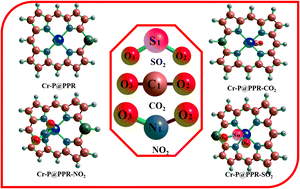
As burning of fossil fuels is a major contributor to air pollution, as a result, both acute and chronic releases of these toxic chemical gases into the air can cause significant damage to the cardiovascular and pulmonary systems, potentially leading to death. This therefore calls for environmental remediation, through the detection of these gases, since they cannot be completely eradicated from the atmosphere. Herein, this research presents a newly tailored phosphorus-doped chromium encapsulation porphyrin (P–Cr@PPR) for the detection of CO2, SO2, and NO2 gas pollutants. The potential of this material as a suitable detector for these gases was studied through various computational analyses, carried out using the DFT/HSEH1PBE/LANL2DZ level of theory. Due to interaction, slight changes in the surface morphology were observed, showing the effect of detection on the surface. All systems showcased high perturbation energy, with the greatest perturbation energies of 909.58 and 481.60 kcal mol−1 observed for the surface upon the adsorption of SO2 gas, showing that the Cr–P@PPR–SO2 complex will be easily stabilized as compared to its counterparts studied. Majorly, slight changes in the surface morphology show the effect of the detection of the surface. Among the systems, non-covalent and partial covalent forms of interactions were observed, with a positive value of ellipticity (ε) showing some degree of ionic character with greater ionic contribution. Lastly, detecting strength follows an increasing order of: NO2–Cr–P@PPR < SO2–Cr–P@PPR < CO2–Cr–P@PPR, with the detection energies recorded as 10.471, 6.503, and 4.581 eV, respectively. Based on the characteristic properties exhibited by this material, it can be a potential candidate to be considered when selecting a material to engineer a detection device for these gas pollutants.
 Please wait while we load your content...


