


 PLATFORM UPDATE:


Multiscale analysis of Rb2NaInI6: from electronic structure to device performance for next-generation perovskite solar cells

Abstract
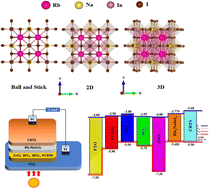
The harmful effects and long-term unpredictability of conventional compounds made from lead have driven a more intense quest for practical, stable, and ecologically acceptable lead-free perovskite components. Among the exciting prospects, the pair of perovskites Rb2NaInI6 stands out for its special structural, electrical, and optical properties, therefore offering a possible subsequent-generation light-absorbing substance for photovoltaic energy and optoelectronic use. We study Rb2NaInI6 holistically in this work, utilizing a mixed computational method. The density functional theory (DFT) computations using WIEN2k verify their cubic F![[m with combining macron]](https://www.rsc.org/images/entities/char_006d_0304.gif) 3m organization with an optimal lattice consistency of 12.25 Å, guaranteeing strong structural integrity. Whereas its density of states (DOS) assessment shows substantial hybridization concerning In-5s and I-5p orbitals, boosting charge transport, the semiconductor band structure provides a secondary bandgap of 0.68 eV. Strong absorption in the visible to light spectrum, with a significant coefficient of attraction and low reflectance (<30%), makes optical analysis very appropriate for solar power plants and optoelectronic device uses. Furthermore, its dielectric material functions alongside refractive index, pointing to great possible usage in photonic devices and wavelength guides. Using SCAPS-1D, we simulate four straight heterojunction topologies, including various electron transport layers (ETLs), ZnO, WS2, WO3, and PCBM, via Pt as the rear contact as well as CBTS as the hole transport layer, thereby exploring its device-level efficiency. Under AM 1.5G enlightenment the FTO/ZnO/Rb2NaInI6/CBTS/Pt arrangement obtained the best leads to between these with an open-circuit voltage (Voc) of 1.39 V, short-circuit current density (Jsc) at 21.39 mA cm−2, fill factor (FF) of 89.83%, particularly a staggering power conversion efficiency (PCE) of 26.84%. When combined with ideal ETLs, Rb2NaInI6 expresses a lucky, lead-free perovskite-absorbing material that opens routes for developing stable, effective, and ecologically conscious solar panels made of perovskite. This work highlights the need to accelerate development and enhance new solar components by merging first-principles modelling with device training exercises.
3m organization with an optimal lattice consistency of 12.25 Å, guaranteeing strong structural integrity. Whereas its density of states (DOS) assessment shows substantial hybridization concerning In-5s and I-5p orbitals, boosting charge transport, the semiconductor band structure provides a secondary bandgap of 0.68 eV. Strong absorption in the visible to light spectrum, with a significant coefficient of attraction and low reflectance (<30%), makes optical analysis very appropriate for solar power plants and optoelectronic device uses. Furthermore, its dielectric material functions alongside refractive index, pointing to great possible usage in photonic devices and wavelength guides. Using SCAPS-1D, we simulate four straight heterojunction topologies, including various electron transport layers (ETLs), ZnO, WS2, WO3, and PCBM, via Pt as the rear contact as well as CBTS as the hole transport layer, thereby exploring its device-level efficiency. Under AM 1.5G enlightenment the FTO/ZnO/Rb2NaInI6/CBTS/Pt arrangement obtained the best leads to between these with an open-circuit voltage (Voc) of 1.39 V, short-circuit current density (Jsc) at 21.39 mA cm−2, fill factor (FF) of 89.83%, particularly a staggering power conversion efficiency (PCE) of 26.84%. When combined with ideal ETLs, Rb2NaInI6 expresses a lucky, lead-free perovskite-absorbing material that opens routes for developing stable, effective, and ecologically conscious solar panels made of perovskite. This work highlights the need to accelerate development and enhance new solar components by merging first-principles modelling with device training exercises.
 Please wait while we load your content...


