


 PLATFORM UPDATE:


Organic electronics: pioneering the future of sustainable and flexible technology
 a
and
Sahbi
Ayachi
*b
a
and
Sahbi
Ayachi
*b
Abstract
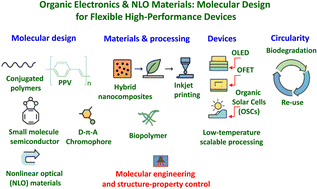
Organic electronics has evolved into a multidisciplinary field bridging molecular design, materials chemistry, and device engineering, enabling lightweight, flexible, and energy-efficient technologies that extend beyond the limits of traditional inorganic systems. This review provides a comprehensive and critical assessment of recent progress in sustainable organic and hybrid electronic materials, highlighting the interplay between molecular structure, processing strategy, and functional performance. The discussion spans conjugated polymers, small-molecule semiconductors, and bio-polymeric systems designed for transient and eco-compatible devices. Quantitative comparisons of mechanical, electrical, and environmental metrics (tensile strength, modulus, conductivity, biodegradability) reveal clear correlations between chemical architecture and device reliability. Emerging nanocomposite frameworks and additive manufacturing routes, including 3D-printable inks and hybrid nanofillers, are highlighted as transformative platforms for scalable and circular fabrication. In parallel, the manuscript examines end-of-life management, recyclability pathways, and life-cycle assessment perspectives, framing sustainability as a measurable design criterion rather than a conceptual goal. Finally, advances in nonlinear optical (NLO) organic materials and their integration into photonic and optoelectronic architectures are discussed as frontiers extending the functional reach of organic systems. By unifying structure–property correlations with manufacturing innovation and ecological responsibility, this review delineates the roadmap toward next-generation, high-performance, and environmentally sustainable organic electronic technologies.
 Please wait while we load your content...


