Issue 34, 2025, Issue in Progress

Design, structure, and application of conductive polymer hybrid materials: a comprehensive review of classification, fabrication, and multifunctionality

Abstract

Conductive polymer (CP) hybrids combine the electronic properties of polymers with the mechanical strength, thermal stability, and catalytic features of secondary materials. This review presents four major structural categories: core–shell assemblies, interpenetrating networks, layered composites, and dispersed nanocomposites. Each class is linked to fabrication routes such as in situ polymerization, electrochemical deposition, solution blending, and sol–gel techniques. We evaluated the influence of these structural forms on performance metrics, including electrical conductivity, flexibility, and long-term durability. Representative applications in sensing, energy storage, corrosion protection, and environmental remediation are examined to highlight their functional advantages and practical limitations. Challenges in synthesis, precision, material stability, and device integration are also discussed. A final roadmap connecting structural design choices to specific application outcomes and outlining priorities for the future development of scalable and multifunctional CP hybrid systems is presented.
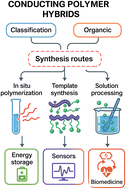
Graphical abstract: Design, structure, and application of conductive polymer hybrid materials: a comprehensive review of classification, fabrication, and multifunctionality

Article information

Article type
Review Article
Submitted
30 Jun 2025
Accepted
23 Jul 2025
First published
04 Aug 2025
This article is Open Access
Creative Commons BY-NC license

RSC Adv., 2025,15, 27493-27523

Design, structure, and application of conductive polymer hybrid materials: a comprehensive review of classification, fabrication, and multifunctionality

A. A. A. Aljabali, A. Alkaraki, O. Gammoh, E. Qnais, A. Alqudah, V. Mishra, Y. Mishra and M. El-Tanani, RSC Adv., 2025, 15, 27493 DOI: 10.1039/D5RA04634C

This article is licensed under a Creative Commons Attribution-NonCommercial 3.0 Unported Licence. You can use material from this article in other publications, without requesting further permission from the RSC, provided that the correct acknowledgement is given and it is not used for commercial purposes.

To request permission to reproduce material from this article in a commercial publication, please go to the Copyright Clearance Center request page.

If you are an author contributing to an RSC publication, you do not need to request permission provided correct acknowledgement is given.

If you are the author of this article, you do not need to request permission to reproduce figures and diagrams provided correct acknowledgement is given. If you want to reproduce the whole article in a third-party commercial publication (excluding your thesis/dissertation for which permission is not required) please go to the Copyright Clearance Center request page.

Read more about how to correctly acknowledge RSC content.

Social activity

Spotlight

Advertisements