Issue 38, 2025, Issue in Progress

Computational insights into phthalimide-core non-fullerene acceptors for next-generation organic solar cells

Abstract

Traditional fullerene-based acceptors in organic solar cells (OSCs) suffer from limitations such as poor tunability, narrow absorption spectra, and limited morphological stability, restricting further improvements in device efficiency. To address these challenges, non-fullerene acceptors (NFAs) with tunable energy levels and broad optical absorption have gained increasing attention. In this study, seven novel phthalimide core-based donor–acceptor molecules (BPDM1–BPDM7) are computationally designed by modifying the terminal units of a reference molecule (BPDF). Using density functional theory (DFT) and time-dependent DFT (TD-DFT) calculations at the B3LYP/6-31G(d,p) level, photovoltaic parameters such as bandgap, frontier orbital energies, absorption maxima, light harvesting efficiency (LHE), reorganization energies (λe, λh), dipole moments, open-circuit voltages (Voc), and fill factors (FF) are systematically evaluated. The designed derivatives exhibit narrow bandgap (1.84–2.18 eV) and red-shifted absorption (681–829 nm). BPDM3 shows the lowest bandgap (1.84 eV). BPDM7 achieves the highest dipole moment (3.88 D), Voc (1.93 V), and FF (92.96%), while BPDM4 displays the lowest λe and λh values, indicating superior charge mobility. The reduced exciton binding energies across all derivatives suggest enhanced charge separation capabilities. These results not only provide a pathway for rational NFA design but also serve as a theoretical foundation for future experimental development of high-efficiency OSCs.
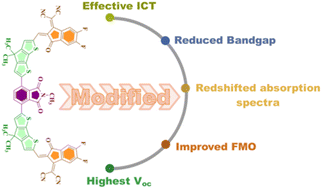
Graphical abstract: Computational insights into phthalimide-core non-fullerene acceptors for next-generation organic solar cells

Supplementary files

Transparent peer review

To support increased transparency, we offer authors the option to publish the peer review history alongside their article.

View this article’s peer review history

Article information

Article type
Paper
Submitted
25 Jun 2025
Accepted
14 Aug 2025
First published
29 Aug 2025
This article is Open Access
Creative Commons BY-NC license

RSC Adv., 2025,15, 31019-31031

Computational insights into phthalimide-core non-fullerene acceptors for next-generation organic solar cells

Z. Khan, H. J. Alathlawi, K. H. Salem, S. M. K. A. Naqvi, I. H. Jaghdam, M. S. Soliman, T. H. A. Hasanin, S. Ali, H. N. Bhatti and R. A. Khera, RSC Adv., 2025, 15, 31019 DOI: 10.1039/D5RA04527D

This article is licensed under a Creative Commons Attribution-NonCommercial 3.0 Unported Licence. You can use material from this article in other publications, without requesting further permission from the RSC, provided that the correct acknowledgement is given and it is not used for commercial purposes.

To request permission to reproduce material from this article in a commercial publication, please go to the Copyright Clearance Center request page.

If you are an author contributing to an RSC publication, you do not need to request permission provided correct acknowledgement is given.

If you are the author of this article, you do not need to request permission to reproduce figures and diagrams provided correct acknowledgement is given. If you want to reproduce the whole article in a third-party commercial publication (excluding your thesis/dissertation for which permission is not required) please go to the Copyright Clearance Center request page.

Read more about how to correctly acknowledge RSC content.

Social activity

Spotlight

Advertisements