


 PLATFORM UPDATE:


Exploring the potential of MXenes in advanced energy, environmental, and biomedical applications

Abstract
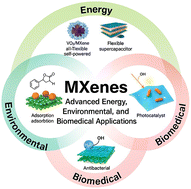
MXenes, a rapidly expanding family of 2D transition metal carbides, nitrides, and carbonitrides, have emerged as a ground-breaking class of materials thanks to their specifications as customizable surface chemistry, and electrical conductivity. Since their emergence, MXenes have demonstrated their adaptability in a numerous applications, from electronics and biomedicine to energy conversion and storage, environmental clean up, and water purification. This article provides a thorough and critical review of the state-of-the-art in MXene research, covering recent synthesis studies (from traditional HF etching to more environmentally friendly and bottom-up approaches) and the constantly evolving understanding of how MXene structure influences properties. Their usefulness for energy storage devices is highlighted, as their electrochemical characteristics make them excellent candidates for next-generation lithium/sodium-ion batteries and supercapacitors. We proceed to discuss their potential in electrocatalysis, water purification, sensing and biomedical engineering and comment on the correlation between surface functionality and architecture and the corresponding performance in a given application. By bridging recent experimental evidence with theoretical foundations, the article summarizes existing knowledge and highlights topical challenges to advance MXene research in the future. The review concludes a vision of the near future on scalable production and surface modification and interdisciplinary integration towards enabling MXenes in high-performance and multifunctional applications.
- This article is part of the themed collection: 2025 Reviews in RSC Advances
 Please wait while we load your content...


