


 PLATFORM UPDATE:


Production, characterization, and antimicrobial activity of polyhydroxyalkanoates synthesized by Bacillus species against skin pathogens

Abstract
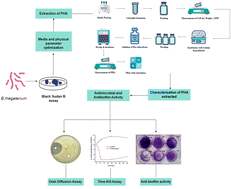
Polyhydroxyalkanoates (PHAs) are biodegradable polyesters with promising biomedical applications, particularly for combating antibiotic-resistant skin infections, in the development of wound dressings and other healthcare materials. The growing challenge of antibiotic-resistant skin infections has been managed by exploiting PHAs as an alternative to synthetic materials due to their sustainability, eco-friendly nature and antimicrobial functionality. This research used an orthogonal experimental design for PHB optimization, and the results demonstrated that ammonium sulphate (2 g L−1), glucose, 10% NaCl, and 67 h incubation maximized PHB yield (46.7%). Citric acid supplementation (2–4 g L−1) enhanced acetyl-CoA flux, increasing PHB synthesis. The extracted PHB was characterized using FTIR, 1H-NMR, and 13C-NMR spectroscopies, confirming the presence of poly-3-hydroxybutyrate (PHB). Thermal and structural characterization of the synthesized PHB confirmed its semi-crystalline nature and enhanced thermal stability. TGA, DSC, and XRD analyses revealed high degradation temperatures, distinct melting and crystallization transitions, and well-defined diffraction peaks, indicating a stable and structurally ordered polymer. PHB exhibited potent antimicrobial activity against skin pathogens, with zones of inhibition of 16 mm for Staphylococcus aureus, 14 mm for S. epidermidis, and 10 mm for Candida albicans at 1000 μg per disk. The MIC values were 400 μg mL−1 for S. aureus, 600 μg mL−1 for S. epidermidis, and 1000 μg mL−1 for C. albicans. Time-kill assays showed complete eradication of S. aureus within 8 h. PHB also disrupted biofilms, achieving 60% inhibition (co-incubation) and 70% eradication (preformed biofilms) at MIC concentrations. The XTT assay revealed PHA's dose-dependent anti-biofilm activity. Co-incubation with 600 μg mL−1 PHB strongly inhibited biofilms (24–55% viability), while 1000 μg mL−1 nearly eradicated bacterial biofilms (12–16% viability). PHB also disrupted the preformed biofilms, showing stronger activity against Gram-positive bacteria than against C. albicans. This study underscores the potential of B. megaterium-derived PHB as an eco-friendly antimicrobial agent against resistant skin pathogens, aligning with global efforts to replace synthetic plastics and antibiotics.
 Please wait while we load your content...


