


 PLATFORM UPDATE:

Catalytic engineering of a cerium vanadate–bismuth vanadate system to yield a bifunctional photocatalyst for simultaneous hydrogen generation and pollutant degradation

Abstract
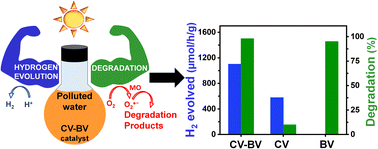
A cerium vanadate–bismuth vanadate (CV–BV) composite is developed to facilitate dual functionality in photocatalytic hydrogen generation and degradation and is synthesized via a one pot hydrothermal method. Despite its strong pollutant degradation capability, BV remains ineffective for hydrogen evolution, whereas CV, with favourable band position, actively participates in hydrogen evolution. BV shows a pollutant degradation rate of 90% in 1 hour but does not produce hydrogen, while CV exhibits a hydrogen evolution rate of 590.0 μmol h−1 g−1 but only a 10% degradation of methyl orange (MO) for the same duration. Notably, the CV–BV heterojunction, governed by an S-scheme mechanism that favours charge carrier separation and redox potential, exhibits excellent performance, simultaneously achieving a hydrogen evolution rate of 1011 μmol h−1 g−1 and a 98% degradation efficiency for MO. The total organic carbon analysis indicates 93% removal of organic carbon from the dye solution. The system maintains stable catalytic performance over five consecutive cycles, indicating its durability. The solar-to-hydrogen (STH) efficiency for the CV–BV system is determined to be 3.99%. The activity of the CV–BV catalyst is demonstrated in actual wastewater, achieving 96% dye degradation and 803.0 μmol h−1 g−1 hydrogen generation. Its dual performance remained effective even in MO-contaminated seawater (310.0 μmol h−1 g−1 and 98% MO degradation), proving its adaptability to harsh, complex environments. The heterojunction efficiently absorbs a broad light spectrum, generating electron–hole pairs, and conduction band electrons of CV participate in proton reduction to produce hydrogen in the presence of a hole scavenger while superoxide radicals partake in degradation as proven from the radical trapping experiments. The synergistic S-scheme charge transfer mechanism within the CV–BV system enhances its bifunctional efficiency, demonstrating significant potential for fuel generation from wastewater with simultaneous environmental remediation.
 Please wait while we load your content...


