


 PLATFORM UPDATE:

Electro/photo multi-energy triggered expanded graphite/polyethylene glycol composite phase change materials for wearable thermotherapy

Abstract
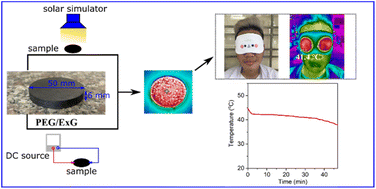
In this work, we combined expanded graphite (ExG) and polyethylene glycol (PEG) to fabricate composite phase change materials (CPCMs) with effective photo/electrothermal conversion and storage, potentially applied to thermotherapy. The CPCMs were studied with varying contents of PEG (60, 70, 80, and 90%), showing good leakage-proof ability at a PEG content of up to 90% and high crystallization fractions of 94.4–98.7%. These two factors promoted a high thermal energy storage capacity of 151.1 J g−1 for the fabricated CPCM90 (the CPCM with 90% PEG). The CPCMs also exhibited good cycling durability, high thermal stability, and elevated thermal conductivities of 3.201–7.683 W (m−1 K−1), which were 11.6–27.9 times above that of pure PEG. The high electrical conductivity and light absorption of ExG allowed effective electro/photothermal conversion and storage for the CPCMs. For example, the CPCM90 could be heated from the ambient to 70 °C in 390 s, as applied with a low electrical energy of 1.5 V. It also exhibited a high photothermal conversion efficiency of 84.0% at a simulated solar radiation of 1000 W m−2. The CPCM90 was further evaluated for practical thermotherapy application as a heat eye-patch, which could maintain temperatures within 40.0–42.5 °C for 37 min. This temperature range and duration were highly desired for eye relaxation and therapy of some eye issues.
 Please wait while we load your content...


