


 PLATFORM UPDATE:


Molecular insights into aggregate speciation of diglycolamides for efficient extraction of rare earth elements
 *ab
*ab
Abstract
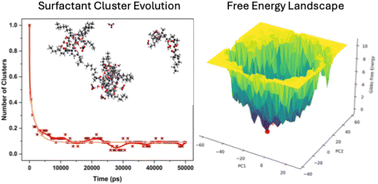
Hypothesis: Diglycolamides (DGAs) are widely employed as solvation extractants in industrial lanthanide separations. In solvent extraction, reverse aggregation enables these extractants to form complexation sites that significantly influence extraction yield. Although extraction is parametrically controlled, its efficiency is governed by poorly characterized phenomenological behavior. Therefore, improved control over nanoscale aggregate speciation is expected to enhance extraction efficacy at the macroscale. A multiscale framework can thus be applied to rationalize aggregation phenomena under process-relevant conditions, facilitating development of strategies to modulate solvent-phase structuring and thereby optimize extraction efficacy. Experiments/simulations: Aggregation tendency of DGAs is enhanced by polar infiltration from aqueous phase. To mechanistically analyze this behavior, a systematic multistage investigation was conducted on the reverse aggregation of N,N′-dimethyl-N,N′-di(n-octyl)diglycolamide (DMDODGA), a low-lipophilicity DGA, in n-dodecane over a representative experimental range of nitric acid and water concentrations, using molecular dynamics (MD) simulations. Findings: Cluster dynamics exhibit exponential decay, consistent with Smoluchowski's formalism. Aggregates are metastable, with nitric acid acting as a chaotropic agent at low concentrations and shifting to a kosmotropic role at higher levels. Counterions with greater solvating character in the Hofmeister series tend to favor the formation of small to intermediate aggregates. Hydrogen bonding enables water to consistently function as a kosmotropic agent, promoting the formation of larger assemblies. Free energy analysis indicates that systems with narrower cluster distributions and higher nitric acid-to-water ratios exhibit greater aggregate stability.
 Please wait while we load your content...


