Issue 36, 2025, Issue in Progress

Surface-modified polyimide on novel porous ceramic membranes for pervaporation desalination

Abstract

Although pervaporation (PV) desalination is a promising solution to global freshwater scarcity, membranes suffer from unstable separation performance. This study utilized resource recycling to prepare a porous ceramic membrane using solid waste fly ash as raw material, which was then combined with polyimide (PI) to produce a high-performance composite membrane (abbreviated to as PI/ceramic membrane). In this composite membrane, the ceramic membrane provides mechanical support and promotes rapid water passage, while the PI layer intercepts hydrated salt ions through size screening and electronic repulsion. Through their synergistic action, the composite membrane can preferentially adsorb and diffuse water molecules while retaining. Results indicate in addition to a retention efficiency of nearly 99.9%, the PI/ceramic membranes achieved a permeability of 10.88 L (m−2 h−1), which is superior to other existing polymer-modified membranes. Simultaneously, the membrane demonstrates selective ion rejection (e.g., SO42− and Mg2+) while maintaining stable rejection performance at 90 °C. A 45-hour continuous operation test confirmed the composite membrane's stability, demonstrating consistent performance. This study provides a novel approach for the preparation of polymer-modified membranes for industrial wastewater desalination.
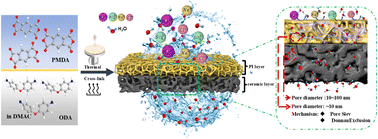
Graphical abstract: Surface-modified polyimide on novel porous ceramic membranes for pervaporation desalination

Supplementary files

Transparent peer review

To support increased transparency, we offer authors the option to publish the peer review history alongside their article.

View this article’s peer review history

Article information

Article type
Paper
Submitted
27 May 2025
Accepted
22 Jul 2025
First published
19 Aug 2025
This article is Open Access
Creative Commons BY-NC license

RSC Adv., 2025,15, 29142-29148

Surface-modified polyimide on novel porous ceramic membranes for pervaporation desalination

B. He, J. Geng, H. Liu, Y. Li, T. Luo and C. Gao, RSC Adv., 2025, 15, 29142 DOI: 10.1039/D5RA03719K

This article is licensed under a Creative Commons Attribution-NonCommercial 3.0 Unported Licence. You can use material from this article in other publications, without requesting further permission from the RSC, provided that the correct acknowledgement is given and it is not used for commercial purposes.

To request permission to reproduce material from this article in a commercial publication, please go to the Copyright Clearance Center request page.

If you are an author contributing to an RSC publication, you do not need to request permission provided correct acknowledgement is given.

If you are the author of this article, you do not need to request permission to reproduce figures and diagrams provided correct acknowledgement is given. If you want to reproduce the whole article in a third-party commercial publication (excluding your thesis/dissertation for which permission is not required) please go to the Copyright Clearance Center request page.

Read more about how to correctly acknowledge RSC content.

Social activity

Spotlight

Advertisements