


 PLATFORM UPDATE:


Exploring allosteric properties of mammalian ALOX15: octyl (N-(4-(benzofuran-2-yl)-2-methoxyphenyl)sulfamoyl)- and octyl (N-(4-(1H-indol-2-yl)-2-methoxyphenyl)sulfamoyl)carbamates as ALOX inhibitors
 a
Alejandro
Cruz,
b
Vladislav
Aksenov,
a
Alexander
Zhuravlev,
a
Alexey
Golovanov,
a
José M.
Lluch,
c
Hartmut
Kuhn,
d
Igor
Ivanov
*a
and
Àngels
González-Lafont
*c
a
Alejandro
Cruz,
b
Vladislav
Aksenov,
a
Alexander
Zhuravlev,
a
Alexey
Golovanov,
a
José M.
Lluch,
c
Hartmut
Kuhn,
d
Igor
Ivanov
*a
and
Àngels
González-Lafont
*c
Abstract
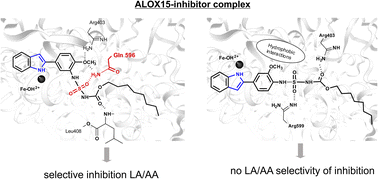
Mammalian ALOX15 are allosteric enzymes but the mechanism of allosteric regulation remains a matter of discussion. Octyl (N-(5-(1H-indol-2-yl)-2-methoxyphenyl)sulfamoyl)carbamate inhibits the linoleate oxygenase activity of ALOX15 at nanomolar concentrations, but oxygenation of arachidonic acid is hardly affected. The mechanism of substrate selective inhibition suggests inter-monomer communication within the allosteric ALOX15 dimer complex, in which the inhibitor binding to monomer A induces conformational alterations in the structure of the active site of monomer B. Interactions of the NH-group of the indole moiety with the Fe(III)–OH− cofactor or of the SO2 group of the sulfocarbamate moiety with the side chain NH2 group of Gln596 may be important for proper inhibitor placement in the ALOX15 allosteric complex. Substitution of a H-bond donor to a H-bond acceptor (NH–O-exchange) impacts but does not eliminate the ability of the compound to inhibit preferentially the LA-oxygenase activity of ALOX15. In contrast, swapping the positions of CH3O- and NH groups at the 2-aryl moiety led to a loss of substrate selective inhibition. In silico docking studies and molecular dynamics-simulations using a dimeric allosteric ALOX15 model have shown that binding of the substrate molecule to ALOX15 monomer B may alter the structure of the monomer A-inhibitor complex forcing the inhibitor to adopt a different binding mode. Taken together, this data suggests the possibility of two-way communication between ALOX15 monomers during enzymatic catalysis.
 Please wait while we load your content...


