


 PLATFORM UPDATE:


Green synthesis of iron-doped cobalt sulfide via synergistic electronic and structural engineering in ethaline deep eutectic solvent for efficient oxygen evolution reaction
 *ab
*ab
Abstract
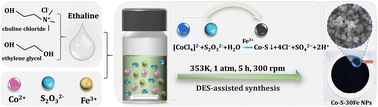
The development of high-efficiency, earth-abundant electrocatalysts for the oxygen evolution reaction (OER) is essential for scalable green hydrogen production, yet challenges persist in balancing activity, stability, and cost. Herein, we present a sustainable approach to synthesize Fe-doped cobalt sulfide (Co–S–30Fe) nanoparticles using an ethaline deep eutectic solvent-mediated strategy, which enables precise control over Fe incorporation to optimize both structural and electronic properties. The engineered Co–S–30Fe/NF electrode exhibited exceptional OER performance in alkaline media, requiring an overpotential of only 278 mV at 100 mA cm−2, with a Tafel slope of 44.6 mV dec−1 and outstanding operational stability. Spectroscopic analyses revealed that Fe3+ doping induces three synergistic effects: (1) coexistence of dynamically active Co2+/Co3+ and Fe2+/Fe3+ redox couples, (2) substantial oxygen vacancy generation, and (3) ethaline-directed self-assembly of monodisperse nanospheres (∼96 nm) with 31.6% higher electrochemical surface area. This synergy of electronic reconstruction, defect engineering, and morphology control significantly enhances charge transfer kinetics (67% reduction in charge-transfer resistance) and intrinsic catalytic activity (4.4-fold increase in turnover frequency) compared to undoped Co–S. Critically, in situ electrochemical reorganization during the OER induced a surface transformation into oxygen-rich Co(Fe)–O/OH species, addressing the activity–stability trade-off. When integrated into a Co–S–30Fe/NF‖Pt/C/NF electrolyzer, the system achieved overall water splitting at low cell voltages of 1.53 V and 1.75 V (10 and 100 mA cm−2, respectively) while maintaining stable operation for 100 h at 10 mA cm−2.
 Please wait while we load your content...


