


 PLATFORM UPDATE:


Theoretical study on the mechanisms and kinetics of nitrous acid with the simplest aromatic Criegee intermediate
 *a
*a
Abstract
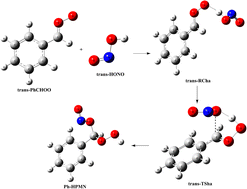
Nitrous acid (HONO) is a vital pollutant gas and the nitrogen-containing organic compounds (NOCs) produced by its reaction are the main components of aerosols. The reaction mechanisms and kinetics of HONO and the simplest aromatic Criegee intermediate (PhCHOO) are investigated by density functional theory and transition state theory in this study. The results demonstrate that cycloaddition of HONO and PhCHOO to form heteroozonide with the highest activation energy and smallest rate constant does not easily occur. Pathways of oxygen atom transfer and cycloaddition can form in situ HNO3 and benzoic acid. Meanwhile, the hydrogen atom transfer pathway results in the generation of phenyl hydroperoxide methyl nitrite (Ph-HPMN), which has the lowest activation energy, dominating the reaction between HONO and PhCHOO with a rate constant (5.68 × 10⁻¹³ cm3 per molecule per s) close to that with OH radicals (4.83 × 10⁻¹² cm3 per molecule per s). These results provide a theoretical reference for clarifying the mechanism of generation of NOCs formed from ozonolysis of styrene and other olefin compounds in the presence of HONO.
 Please wait while we load your content...


