


 PLATFORM UPDATE:


Silver chloride–poly-2-chlorobenzeneamine complex nanocomposite as photoelectrode for photoelectrochemical hydrogen gas generation from seawater

Abstract
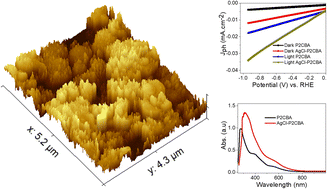
An innovative silver chloride–poly(2-chlorobenzeneamine) (AgCl–P2CBA) complex nanocomposite is developed through a one-step chemical synthesis route for efficient and sustainable hydrogen production from seawater. The resulting nanocomposite exhibits a rough, heterogeneous surface morphology, an optical bandgap of 1.92 eV, and an average crystallite size of approximately 40 nm, which collectively enhance its light-harvesting and photoresponse properties. The integration of AgCl into the polymeric matrix not only improves visible-light absorption but also facilitates more effective charge carrier separation, leading to a marked increase in photocurrent density from −0.011 mA cm−2 (pure P2CBA) to −0.035 mA cm−2 for the composite. Under solar illumination, the AgCl–P2CBA photocathode achieved a hydrogen evolution rate of 3.5 μmol h−1 cm−2 using untreated seawater, demonstrating excellent activity and stability. Additionally, the electrode remained responsive across a broad photon energy range (1.7–3.6 eV), underscoring its adaptability to diverse lighting conditions. This work presents an innovative combination of a halide salt with a chlorinated conducting polymer, offering a simple, scalable, and cost-effective photoelectrode design with strong potential for practical hydrogen generation technologies.
 Please wait while we load your content...


