


 PLATFORM UPDATE:


Construction of octanuclear polyoxomolybdenum(v)-based porous materials with lithium additives
 b
Zhao-Hui
Zhou
*a
b
Zhao-Hui
Zhou
*a
Abstract
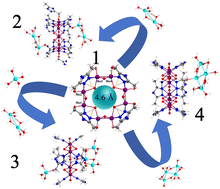
Crown-ether-like octanuclear polyoxymolybdenum(V) cluster (NH4)4[Mo8O8(μ2-OH)4(μ2-O)8(dmtrz)8]·62.5H2O (dmtrz = 3,5-dimethyltriazole, 1) was successfully synthesized by a hydrothermal method. Its lithium additives Li4[Mo8O8(μ2-OH)4(μ2-O)8(dmtrz)8]·2(Hdmtrz)·27H2O (2), Li4[Mo8O8(μ2-OH)4(μ2-O)8(dmtrz)8]·20.5H2O (3) and Li4[Mo8O8(μ2-OH)4(μ2-O)8(dmtrz)8]·25H2O (4) have also been obtained and fully characterized respectively. The lithium cations are in the forms of mononuclear, dinuclear and tetranuclear units. X-ray structural analyses show that polyoxometalate-based materials 1–4 constitute round pores formed by eight molybdenum-oxygen groups connected sequentially with sizes of 4.6 Å. With 1 as the basic framework, 2–4 combine lithium cations in the forms of different hydrates, respectively. In addition, 1 stacked up intermolecularly with pores of sizes 10.0 × 18.0 Å2, while 4 stacked up inter-molecularly with 6.0 × 4.0 Å2 in the a axis and 8.0 × 5.8 Å2 in the c axis, respectively. The results show that 1 can selectively adsorb CO2 and O2, respectively.
 Please wait while we load your content...


