


 PLATFORM UPDATE:


A method based on 10B isotope tracer for seepage detection in salt lakes
 *a
and
*a
and
Abstract
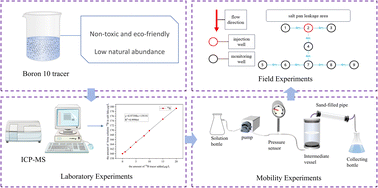
To address the technical challenges of monitoring brine seepage in salt lakes, this study pioneers the application of 10B isotope tracer to seepage detection, establishing a high-precision monitoring system that provides scientific foundations for precise seepage channel identification and flow field characterization. Systematic laboratory experiments validate the exceptional performance of the 10B tracer, including ultra-trace detection sensitivity of 10−9, a stable recovery rate of 92.8–106.5%, adsorption loss below 6.31%, and light transmittance and acid-base resistance retention rates exceeding 95%, confirming its reliability and applicability in complex high-salinity brine systems. Compared to the fluorescein control test, the 10B tracer demonstrated greater advantages in adsorption rate and buffered pH resistance. Mobility experiments further reveal inert-like migration characteristics of the 10B tracer across media, with a breakthrough curve highly similar that of chloride ions. Its rapid transport capability and low retention loss below 20% enable real-time tracking of seepage pathways, offering critical technical support for dynamic flow field analysis. Field experiments reveals that the main seepage path in the salt field leakage system is 2 → 1 → 6, dominated by a fracture system with rapid flow and high connectivity. The secondary seepage path is 2 → 1 → 4 → 6, formed by the interaction of fractures and micro-pores, characterized by fluctuating concentrations and low transmission efficiency. The rapid response and stable flow of the main path highlight the hydraulic dominance of the fracture system, while the oscillating behavior of the secondary path reflects geological heterogeneity and uneven pore distribution. For well 3, Peclet number calculation yielded Pe >1, with absent 10B tracer inflow primarily caused by an auxiliary plugging mechanism. Delayed responses and weak signals in edge wells including well 5 and well 7 further confirm permeability barriers. These findings provide critical guidance for precise seepage control engineering.
 Please wait while we load your content...


