


 PLATFORM UPDATE:


Photo-driven color-conversion display based on a thermochromic-liquid-crystal and carbon-nanotube film
 *a
*a
Abstract
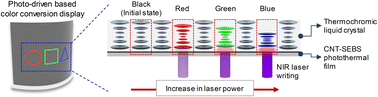
Light-irradiation-based color-conversion displays are considered an emerging technology with considerable potential because they are easy to fabricate; however, color precision is limited by inefficient heating and uneven temperature distribution, and pattern extinction is delayed by poor heat dissipation. This study proposes a light-irradiation-based color-conversion display that can produce full color from a near-infrared (NIR) laser using carbon nanotubes (CNTs) with efficient photothermal conversion and heat-diffusion functions. Light-irradiation-based color-conversion displays have a more straightforward structure than conventional electronic-circuit-based displays. The proposed design uses an NIR laser as the driving energy source, which makes it highly efficient. In addition, a color-conversion layer based on a thermochromic liquid crystal (TLC) changes the color to red, green, or blue depending on the temperature, and a CNT-based thermal property control layer, which reacts to NIR photothermally, is used to achieve immediate thermal control. These layers can be applied to a flexible substrate to maintain stable performance, even under bending or deformation. Precisely controlling the laser power can help achieve a subtle temperature change of 27–32 °C and generate a corresponding color change in a specific area of the TLC-based color-conversion layer. Considering rapid and reversible color conversion is achievable by turning the NIR laser on and off, this method is suitable for various applications, such as high-speed responsive displays, smart sensors, and customizable visual information systems.
 Please wait while we load your content...


