


 PLATFORM UPDATE:


Enhanced electrochemical sensing of lead in environmental samples using Bi2O3/IL/rGO hybrid nanocomposite
 *a
and
*a
and
Abstract
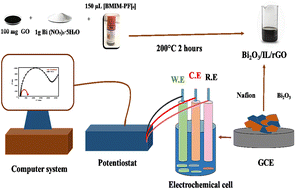
The current study uses the ionic liquid (IL) 1-butyl-3-methylimidazolium hexafluorophosphate, also known as BMIM-PF6, as a stabilizing agent to synthesize a bismuth oxide/ionic liquid/reduced graphene oxide (Bi2O3/IL/rGO) hybrid nanomaterial. A range of techniques, including scanning electron microscopy (SEM), X-ray diffraction (XRD), energy dispersive X-ray spectroscopy (EDX), Fourier transform infrared spectroscopy (FTIR), and UV-visible spectroscopy, were used to characterize the synthesized Bi2O3/IL/rGO nanocomposite. XRD confirmed that the composite was crystalline, and FTIR analysis suggested the presence of certain functional groups. The main elements oxygen, carbon, and bismuth were confirmed by EDX analysis, and SEM imaging showed an exfoliated and detached morphology. The synthesized nanocomposite was used to modify a glassy carbon electrode to develop a sensor for the detection of lead (Pb2+). The fabricated sensor was characterized using electrochemical impendence spectroscopy (EIS) and cyclic voltammetry (CV). The results indicated that the Bi2O3/IL/rGO/GCE was more conductive, having a charge transfer resistance (Rct) of 428.5 Ω compared to 1870 Ω for the bare electrode. The sensor has a low detection limit of 0.001 μM and a quantification limit of 0.003 μM. When tested on water and soil samples, the sensor was confirmed to have acceptable recovery rates, ranging from 95% to 102%. In conclusion, our fabricated sensor has excellent performance in terms of ease, affordability, energy usage, and quick efficiency.
 Please wait while we load your content...


