


 PLATFORM UPDATE:


Branched siloxane axial substituents outperform linear analogues in a model silicon phthalocyanine-based organic thin film transistor
 ab
Halynne R.
Lamontagne,
ab
Joseph G.
Manion,
a
Jaclyn L.
Brusso
*b
and
Benoît H.
Lessard
*ac
ab
Halynne R.
Lamontagne,
ab
Joseph G.
Manion,
a
Jaclyn L.
Brusso
*b
and
Benoît H.
Lessard
*ac
Abstract
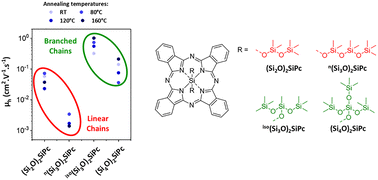
The rational design of organic semiconductors (OSCs) necessitates a deep understanding of structure–property relationships, where side chain engineering is as critical as the conjugated core itself. While hybrid organic–inorganic siloxane side chains have shown great promise for optimizing morphology and charge transport, a systematic study to deconvolute the impact of their architecture in a simplified molecular system has yet to be conducted. To address this, we employ silicon phthalocyanine (SiPc) as an accessible, symmetrical platform to isolate the effects of siloxane substituents. We report the synthesis of a series of axially-substituted siloxane-SiPc derivatives where the length and branching of the siloxane chains are systematically varied. These molecules are integrated into organic thin-film transistors (OTFTs) and comprehensively characterized using atomic force microscopy (AFM), X-ray diffraction (XRD), and ultraviolet photoelectron spectroscopy (UPS). Our results establish clear design rules, revealing that branched siloxane chains are vastly superior to linear analogs. The best derivative molecule, bearing branched 1,1,1,3,5,5,5-heptamethyltrisiloxane chains, achieves a high average hole mobility exceeding 1 cm2 V−1 s−1, a performance nearly three orders of magnitude greater than its linear counterpart. This improvement is attributed to the ability of the branched chains to promote a uniform crystalline texture, smooth morphology, and tighter π-stacking. This work provides fundamental insights and practical guidelines for implementing siloxane chains in next-generation, high-performance organic electronic devices.
 Please wait while we load your content...


