


 PLATFORM UPDATE:


Red-light controlled supramolecular assemblies of N,N′-diarylindigo amphiphiles for soft robotic actuations

Abstract
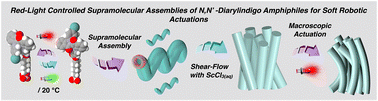
Nature's fundamental processes have inspired the development of robotic systems. Living organisms generate movements through complex molecular mechanisms, particularly evident in muscle tissue, where natural protein motors generate motion across multiple length scales. While traditional rigid robots have achieved significant technological advances, the emergence of supramolecular soft robotics presents promising opportunities for functional applications in biomimetic and stimuli-responsive materials. However, the high structural requirements of supramolecular nanoassemblies in supramolecular soft robotic systems greatly hamper their rapid development. Herein, we demonstrate macroscopic movements of supramolecular visible-light driven soft robotic materials in aqueous media without high orientational order, high aspect ratio, and highly charged nature. Through delicate molecular design of indigo amphiphiles (IAs), the supramolecular assembly behavior of IAs was significantly influenced by altering the alkyl-linker chain lengths, resulting in nanostructures ranging from rod-like micelles to vesicles. Upon red-light laser irradiation to IA supramolecular soft robotic materials, the IA soft robotics bent towards the light source, enabled by transformation of IA nanoassemblies and water ejection from the soft robotics, achieving macroscopic photoactuation function with speed up to 25.4 ± 2.8° min−1. The result paves the way for the design of next generation visible-light controlled biomimetic supramolecular soft robotic systems.
 Please wait while we load your content...


