


 PLATFORM UPDATE:

An in situ synthesized manganese ferrite@4-hydroxy mandelic acid composite for removal of lead ions and Congo red
 *a
Wael I.
Mortada
*b
*a
Wael I.
Mortada
*b
Abstract
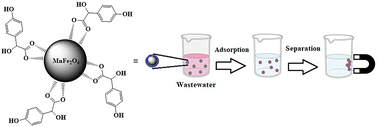
In this study, manganese ferrite doped with 4-hydroxy mandelic acid (MnFe2O4@4-HMA), a novel magnetic nanomaterial, was prepared through a simple one-pot co-precipitation method and characterized using Fourier transform infrared spectroscopy (FT-IR), field emission scanning electron microscopy (FE-SEM), dynamic light scattering (DLS), saturation magnetization, energy dispersive X-ray spectroscopy (EDX), and Brunauer–Emmett–Teller analysis (BET). The synthesized magnetic nanocomposite was used to remove Pb(II) and Congo red (CR) dye from aqueous media. Various parameters impacting the adsorption capacity were examined. The prepared sorbent was mesoporous in nature with a surface area of 291.5 m2 g−1. The optimal parameters for Pb(II) adsorption were achieved at a pH of 6.0, a contact time of 20 min, and a sorbent dosage of 5.0 mg, resulting in a removal percentage of 99.5%. Conversely, the optimum circumstances for CR removal were a pH of 4.0, a contact time of 20 min, and a sorbent mass of 5.0 mg, which led to a removal percentage of 93.9%. The maximum capacities for adsorption were 467.2 and 395.2 mg g−1 for Pb(II) and CR, respectively. The novel composite offers an effective, affordable, and eco-friendly way to remove harmful metal ions and organic dyes from polluted water, showing its usefulness in cleaning wastewater.
 Please wait while we load your content...


