


 PLATFORM UPDATE:


A tetranuclear Zn(ii)-based host–guest MOF resistant to thermal quenching
 *a
Lu-Fang
Ma
a
*a
Lu-Fang
Ma
a
Abstract
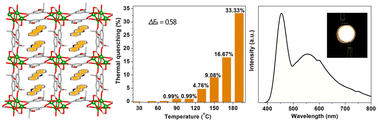
The development of phosphor-converted white-light-emitting diodes for applications in the fields of solid-state lighting and displays has attracted increasing interest due to their high efficiency, small size, and low operating voltage. However, one important issue that cannot be ignored is thermal quenching: heat (∼150 °C) generated by the operated inner diode chips usually causes emission loss in the outer phosphors. Herein, a new tetranuclear Zn(II)-based host–guest MOF was isolated, with the in situ encapsulation of an acridine chromophore. Crystallographic information regarding the relative positions and arrangements of guests, multiple host–guest and guest–guest interactions, and density functional (DFT) calculations were well studied. The host–guest MOF phosphor shows bright yellow emission and a long lifetime of 29.15 ns at room temperature. It exhibits thermal quenching of 9.08% at 150 °C, lower than several reported inorganic phosphors (28–50%). The successful fabrication of a phosphor-converted white-light-emitting diode by the direct integration of a yellow-emission MOF with a blue InGaN chip enables a promising phosphor that can be applied in solid-state lighting.
 Please wait while we load your content...


