


 PLATFORM UPDATE:


Plasmonic Pd nanoparticles at the electrode-semiconductor interface enhance the activity of bismuth vanadate for solar-driven glycerol oxidation

Abstract
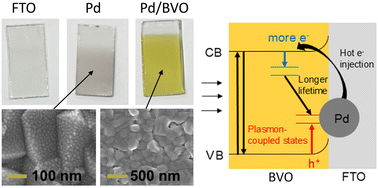
This study demonstrates that the integration of plasmonic palladium (Pd) nanoparticles between a bismuth vanadate (BVO) coating and an electrode interface can significantly improve solar-driven glycerol oxidation. Pd nanoparticles of controllable shape, size and coverage were produced using a novel aerosol-assisted chemical vapour deposition (AACVD) synthetic route and then coated with BVO using the same technique. The nanoparticles enhanced visible light absorption and crystallinity. At 1.23 VRHE, the photocurrent density of bare BVO increased from 0.62 mA cm−2 in the absence of glycerol to 1.20 mA cm−2 with 0.5 M glycerol. When Pd nanoparticles were incorporated beneath BVO, the photocurrent further increased from 0.86 mA cm−2 without glycerol to 1.58 mA cm−2 with 0.5 M glycerol, and the incident photon-to-current conversion efficiency (IPCE) boosted from ∼15% to ∼40% at 400 nm. Ultra-fast transient absorption spectroscopy suggests that the addition of Pd nanoparticles introduces additional charge transfer pathways, including hot electron injection and plasmon-coupled states, which prolong carrier lifetimes and suppress recombination. These combined effects provide a promising strategy to improve the efficiency and durability of photoelectrochemical devices for sustainable fuel generation and selective organic oxidation reactions.
- This article is part of the themed collection: Special collection in celebration of Professor Ivan Parkin on his 60th birthday
 Please wait while we load your content...


