


 PLATFORM UPDATE:


Monochlorination-enabled elevated solar cell performance in region-asymmetric benzothiadiazole-based medium bandgap conjugated copolymers
 a
Junfeng
Tong
*a
a
Junfeng
Tong
*a
Abstract
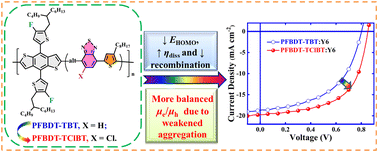
Constructing asymmetric polymeric semiconductors was proved to be an effective strategy for preparing key photoactive layer materials for high-performing organic solar cells. In this investigation, two region-asymmetric medium bandgap (MBG) type conjugated copolymers (CPs), namely PFBDT-TBT and PFBDT-TClBT, in which electron-rich 4,8-bis(4-fluoro-5-(2-butyloctyl)thien-2-yl)benzo[1,2-b:4,5-b′]dithiophene (FBDT) and electron-deficient benzothiadiazole (BT)/5-chlorobenzothiadiazole (ClBT), in conjunction with 3-octylthiophene, were sequentially designated as donors, acceptors, and π-conjugated bridging moieties, were developed, with the primary objective of investigating the role of monochlorination. Monochlorinated PFBDT-TClBT possessed lower thermal stability but better photostability. Monochlorination induced slightly blue-shifted absorption and an unchanged optical bandgap, weakened aggregation both in the solution and thin-film states, deepened EHOMO, resulted in greater twisting geometry, and markedly increased the natural dipole moment. Influenced by this, a chlorine-free PFBDT-TBT:Y6-based device delivered a PCE of 7.77%, with a VOC of 0.80 V, a JSC of 18.67 mA cm−2 and an FF of 51.9%. In contrast, monochlorination facilitated the PFBDT-TClBT-based device to acquire a 0.07 V elevated VOC of 0.87 V, a 5.78% heightened JSC of 19.75 mA cm−2, and a 7.32% increased FF of 55.7%, collectively contributing to an 22.65% increased PCE to 9.53 %. This increase in PCE after monochlorination was mainly due to the deepened EHOMO, better exciton dissociation, suppressed bimolecular recombination and a more balanced μe/µh ratio originating from the desired predominant face-on molecular orientation and reduced aggregation, better miscibility and smoother surface morphology. This finding demonstrated that monochlorination was an effective and promising design approach for improving photovoltaic performance by regulating the molecular structure, energy levels, packing and microstructural morphology.
 Please wait while we load your content...


