


 PLATFORM UPDATE:


A pathway to synthesize 2-methylbenzothiazole derivatives via a hydrogen sulfide promoted tandem reaction of calcium carbide and 2-iodoaniline
 *abcd
*abcd
Abstract
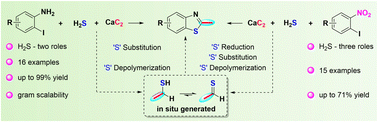
Benzothiazoles, a significant class of nitrogen- and sulfur-containing heterocyclic compounds, are widely utilized in the fields of pesticides and pharmaceuticals. In this study, a novel method for synthesizing 2-methylbenzothiazole derivatives was developed through a multicomponent tandem reaction of 2-iodoaniline, CaC2 and H2S. It was found that H2S reacts with CaC2 to form a pivotal intermediate, ethanethial, which subsequently reacts with 2-iodoaniline to synthesize diverse 2-methylbenzothiazole derivatives in moderate to good yields with excellent functional group compatibility. Additionally, the reductive properties of H2S facilitate the direct transformation of nitro compounds into their corresponding amino derivatives, significantly broadening the substrate scope and enhancing the versatility of this strategy. Importantly, H2S serves three critical roles: depolymerizing CaC2, substituting iodine atoms as a sulfur source, and reducing nitro groups as a reducing reagent. This synthetic method not only provides a practical and efficient pathway for converting CaC2 and H2S gases into 2-methylbenzothiazole derivatives but also highlights the broad applicability of this innovative strategy in organic synthesis.
 Please wait while we load your content...


