


 PLATFORM UPDATE:


Tuning rotational barriers through substituent modification in catechol-diyl molecular gyrotops

Abstract
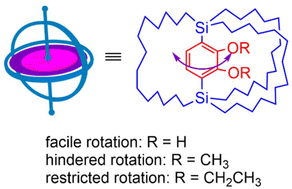
Macrocage molecules bearing a bridged π-electron system represent a unique platform for molecular gyrotops, in which the π-electron system acts as an internal rotor confined within a cage. Here, we report the design and synthesis of a novel molecular gyrotop 1a, incorporating a bridged catechol-3,6-diyl unit, together with its dimethoxy 1b and diethoxy 1c derivatives. Structural characterization and variable-temperature nuclear magnetic resonance (VT-NMR) spectroscopy clearly revealed the active rotational dynamics of the phenylene rotor. Remarkably, systematic tuning of the alkoxy substituents enabled modulation of the rotational energy barriers, highlighting a strategy for engineering controllable internal motion in macrocage frameworks. These findings not only display a new class of molecular gyrotops but also provide design principles for developing functional molecular machines.
 Please wait while we load your content...


