


 PLATFORM UPDATE:


meso-Fused calixbenzipentaphyrin(2.1.1.2.1)s: synthesis, studies and coordination properties

Abstract
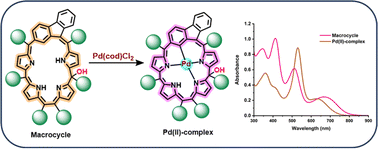
We report the synthesis of three novel meso-fused calixbenzipentaphyrin(2.1.1.2.1) macrocycles in 7–9% yields via a [3 + 2] acid-catalyzed condensation of a fluorene-based tripyrrane with dipyrroethene diols, followed by open-air DDQ oxidation. These macrocycles were unexpected products of the condensation, consisting of six meso-sp2 carbons and one meso-sp3 carbon bearing an –OH group, as confirmed by HRMS, 1D/2D NMR, and theoretical studies. The presence of multiple donor sites including a fused benzene ‘C’, and pyrrolic ‘N's enables efficient coordination, and the macrocycles readily form stable Pd(II) complexes with Pd(cod)Cl2. Spectral and theoretical studies revealed a distorted square-planar geometry around the Pd(II) centre, coordinating to the inner meso-fused ‘C’ and three pyrrolic ‘N's, leaving one pyrrolic NH and the –OH group uncoordinated. The free-base macrocycles exhibit intense absorption bands at 320–580 nm and a broad NIR band at 587–775 nm, which shift bathochromically upon protonation. Pd(II) insertion into the macrocyclic framework induces bathochromic shifts of higher-energy bands and hypsochromic shifts of lower-energy bands. Electrochemical studies show one reversible oxidation and two reversible reductions for both free-base macrocycles and their Pd(II) complexes, with Pd insertion increasing electron deficiency—making the macrocycles harder to oxidize and easier to reduce. Theoretical studies corroborate the experimental data. Collectively, these results highlight the structural adaptability, rich coordination chemistry, and tunable electronic properties of meso-fused calixbenzipentaphyrins.
 Please wait while we load your content...


