


 PLATFORM UPDATE:


Ligand assisted reprecipitation of formamidinium–guanidinium lead iodide 2D perovskite nanowires
 a
Shuichi
Toyouchi,
a
Mayank
Goyal,
b
Nadine
Schrenker,
c
Sumea
Klokic,
d
Peiran
Wang,
a
Heinz
Amenitsch,
d
Emmanuel
Lhuillier,
b
Sara
Bals,
c
Bapi
Pradhan
*a
and
Elke
Debroye
*a
a
Shuichi
Toyouchi,
a
Mayank
Goyal,
b
Nadine
Schrenker,
c
Sumea
Klokic,
d
Peiran
Wang,
a
Heinz
Amenitsch,
d
Emmanuel
Lhuillier,
b
Sara
Bals,
c
Bapi
Pradhan
*a
and
Elke
Debroye
*a
Abstract
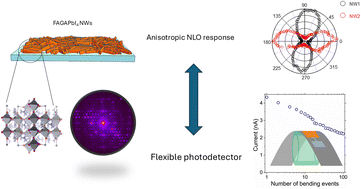
Two-dimensional (2D) lead halide perovskites have emerged as a promising alternative to their three-dimensional counterparts, offering superior ambient stability and enhanced moisture resistance. Additionally, A-site multi-cation perovskites have gained attention for their ability to improve stability and enhance optoelectronic device performance. Despite these advantages, the synthesis of multi-cation 2D perovskites has traditionally been limited by complex and time-intensive methods, hindering their broader application potential. In this work, we demonstrate the use of a ligand-assisted reprecipitation synthesis approach to produce high-quality 2D formamidinium–guanidinium lead iodide perovskites. By varying the ratio of surface capping ligands, aspect-ratio-tuned nanowires (NWs) were obtained. Phase-pure NWs were confirmed from grazing-incidence wide-angle X-ray scattering and 4D scanning transmission electron microscopy. A single particle optical study pointed out that these confined structures of 2D perovskites were shown to exhibit non-linear optical (NLO) anisotropy in the form of third-harmonic generation and two-photon photoluminescence along the growth direction of the NWs. To demonstrate practical applicability, flexible photodetectors based on these NWs were fabricated, exhibiting a two-order-of-magnitude increase of conductance under UV illumination (405 nm) upon increasing the irradiance from 1 mW cm−2 to 1 W cm−2, with sub-50 µs response times. Power-dependent photoconductivity measurements further revealed that photo-carrier generation is limited by a bimolecular recombination process originating from band-to-band recombination, highlighting the intrinsic charge transport dynamics of the system.
 Please wait while we load your content...


