


 PLATFORM UPDATE:


From N-type doping to phase transition in large-area MoS2via controlled sulfur vacancy formation
 b
Geunyoung
Yeom
*b
b
Geunyoung
Yeom
*b
Abstract
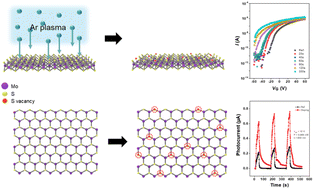
Precise and damage-free doping of two-dimensional semiconductors is essential for advancing their use in nano-electronic and optoelectronic devices. Here, we present a controllable strategy for n-type doping and phase engineering of monolayer MoS2 by tuning sulfur vacancy formation using energy-controlled Ar+ ion treatment. This method enables selective top-layer sulfur removal without disrupting the underlying lattice, leading to enhanced n-type conductivity. Extended plasma exposure induces a phase transition from the semiconducting 2H phase to the metallic 1T phase, as confirmed by Raman, photoluminescence, and X-ray photoelectron spectroscopy. Doped devices exhibit improved electrical and optoelectronic performance, including higher on-current, carrier mobility, and photoresponsivity. Additionally, selective formation of 1T contacts at the source/drain regions further reduces contact resistance and boosts injection efficiency. Al2O3 encapsulation is shown to suppress surface oxidation during O2 plasma exposure, maintaining device stability. This work demonstrates that plasma-assisted defect and phase control offers a practical and scalable pathway to tailor the electronic properties of 2D semiconductors.
 Please wait while we load your content...


